
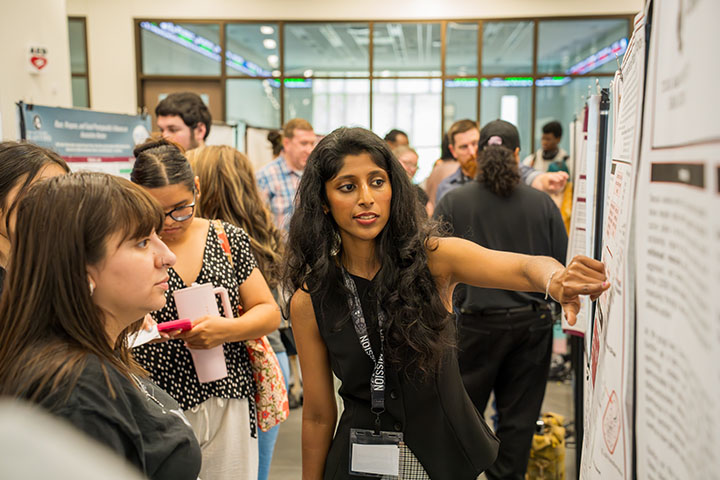
 Students and faculty shared the spotlight at Texas A&M University–San Antonio’s recent Research, Innovation, Scholarship, and Exploration (RISE) Symposium, a campuswide celebration that underscored the University’s growing research culture.
What began in 2012 as a modest, day-and-a-half Student Research Symposium in the College of Arts and Sciences has steadily evolved. The event became university-wide in 2015, was renamed RISE last year, and in 2026 transformed into a full week of panels, showcases, competitions, and awards that intentionally highlighted both student and faculty scholarship.
“Historically, this was an internal student symposium where graduate and undergraduate students presented posters and talks,” said Dr. Davida Smyth, professor and interim director for research development and administration, who helped organize the event. “This year, we wanted to make it bigger, more open, and celebrate the research of both students and faculty. The goal is for RISE to be a weeklong celebration of research, innovation and scholarship.”
Activities like faculty panels and competitions were organized to showcase research done across four thematic groups:
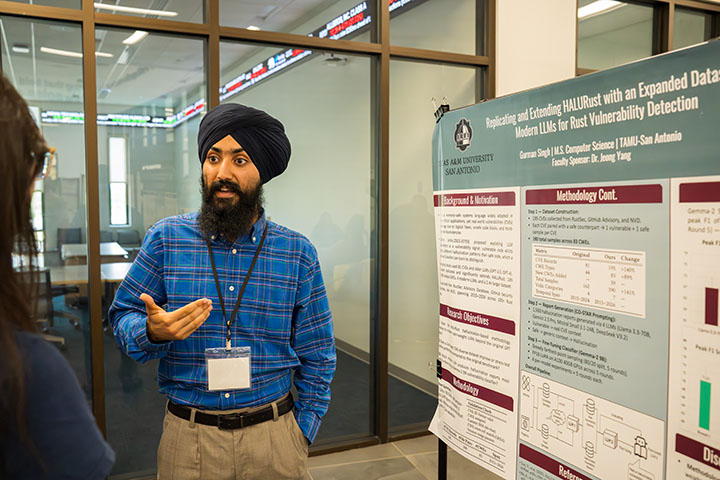 “We established these thematic groups as part of our new ‘Innovation Incubator’ to encourage faculty members to work collaboratively and co-develop grant proposals together,” Smyth said.
In the Borderlands panel, bilingual education professor Dr. Hsiao-ping Wu discussed opportunities through the Fulbright U.S. Student Program, while Honors students Diana Holguin and Albert Hernandez Ontiveros shared their research experiences.
The AI and cybersecurity panel featured Dr. Izzat Alsmadi and Dr. Kuen Gou, who presented their work in computer science and mathematics. The session also welcomed guests from Texas A&M University and the Center for Managed Technical Services, highlighting potential research partnerships and resources available to A&M–San Antonio scholars.
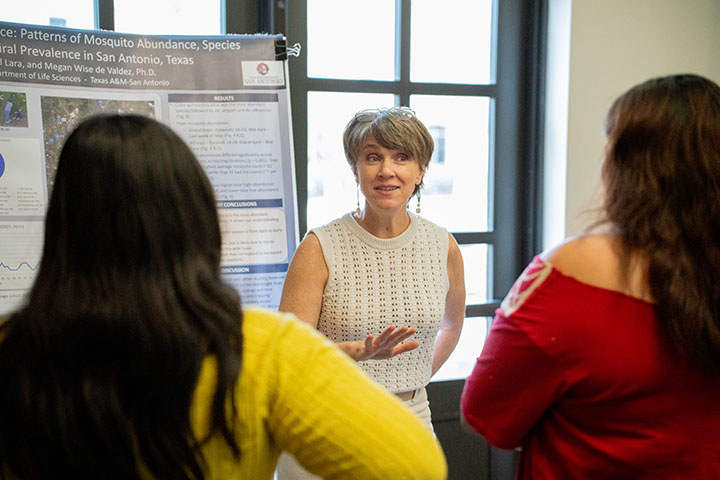
Two panels addressed biomedical and behavioral research, including a discussion of faculty research opportunities. In the conservation and ecology theme, the faculty panel was paired with faculty posters highlighting work in vector surveillance, lizard diversity, and physiology.
Mysti Frazier, assistant director for internships with the Mays Center for Experiential Learning and Community Engagement, led the symposium’s internship showcase that featured posters from students who completed internships in 2025-2026. They presented on how they applied classroom knowledge to real-world settings across San Antonio and beyond.
“It’s going beyond the traditional shadowing of professionals,” Frazier said. “Students are actively contributing to the success of their organizations. Those experiences build confidence, communication skills and a much stronger résumé.”
 Other events included a Research Appreciation Mixer, where faculty were recognized for securing grants in 2025 and 2026. The event also acknowledged faculty who supported the Office of Research and Sponsored Programs, including those who served as internal reviewers for the Texas A&M University Research Excellence Fund, which aims to strengthen the A&M System’s research infrastructure.
There was also the popular Three-Minute Thesis (3MT) competition, where students distilled complex research into engaging presentations for a general audience.
“The idea is to be able to sell your research and make it exciting to anyone in the room,” Smyth said. “It’s really good fun, but it’s also a critical professional skill.”
The symposium’s keynote speaker was Gary Guerra, an A&M–San Antonio alumnus who earned both a bachelor’s and master’s degree in kinesiology and now serves as assistant professor of exercise and sport science at St. Mary’s University. His work has helped raise standards of care for underserved populations worldwide.
Recruited to speak by Dr. John Smith, professor of kinesiology in the College of Education and Human Development, Guerra shared how his cross-disciplinary research has improved prosthetic technology, increased comfort for prosthetic users in resource-limited settings, and deepened understanding of the physical demands of walking with prosthetics.
“Gary has done some amazing things,” Smith said. “He continues to work on prosthetics, and students really connected with how he uses research to serve people in need.
The keynote was followed by a well-attended lunch and the largest student poster and oral presentation session in the event’s history, featuring 46 posters from students across all three colleges.
RISE Week concluded with a 3MT Winners’ Showcase, awards ceremony and celebration of Jaguar research accomplishments.
For organizers, the week’s strong attendance and record participation signaled more than a successful event. It demonstrated A&M–San Antonio’s accelerating momentum in areas such as artificial intelligence, healthcare research, conservation science and borderlands scholarship.
“There’s a lot of research strength at the University,” Smyth said. “And we’re only getting better.”